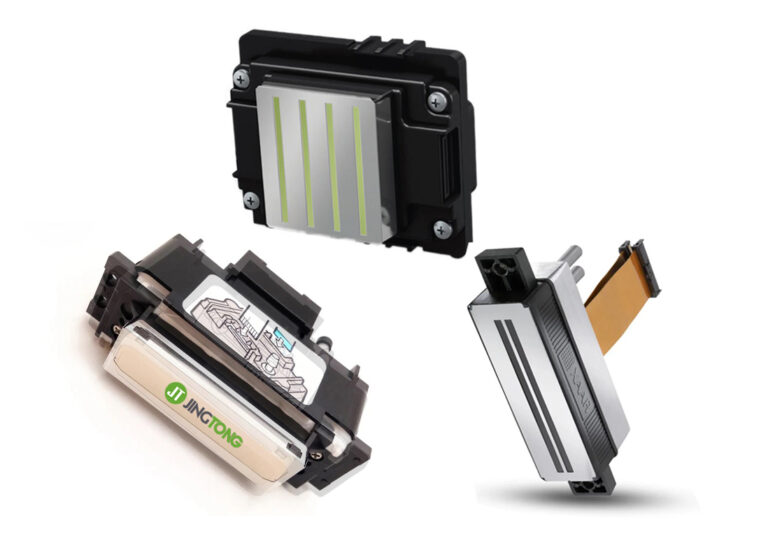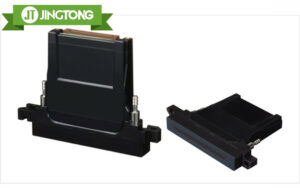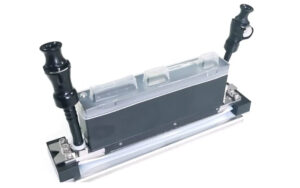
The Epson S3200 vs Kyocera KJ4B-QA06 comparison is useful for manufacturers choosing printheads for industrial inkjet and digital textile printing systems. Both are designed for production environments, but they differ in print width, nozzle arrangement, ink specifications, and system integration requirements.
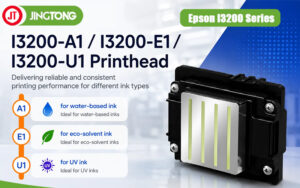
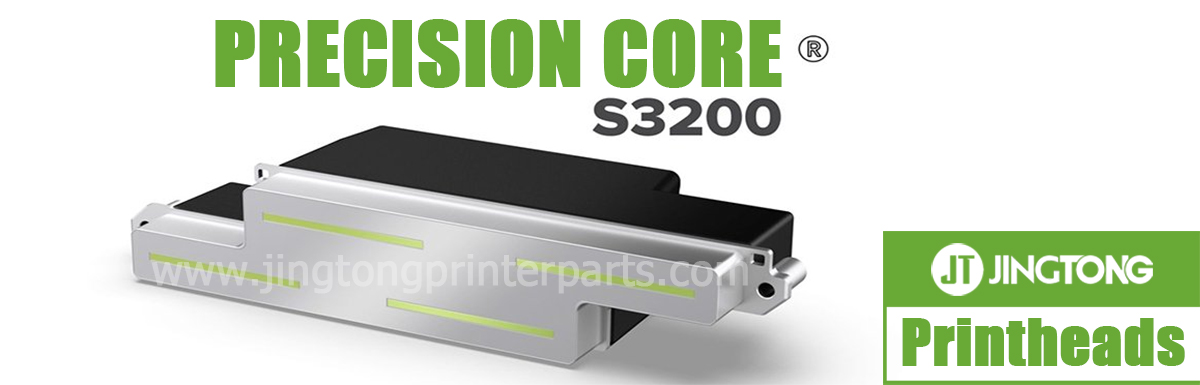
The Epson S3200 family includes variants for different ink types. The S3200-U1 is specified for UV and eco-solvent ink, while the S3200-A1 is designed for aqueous ink. Kyocera KJ4B-QA is designed for aqueous-based ink applications. Always compare the exact model intended for the machine.
Key Specifications
| Specification | Epson S3200-U1 | Kyocera KJ4B-QA |
| Nozzle spacing and effective printing width | 600dpi, 4.73 inches(about 120mm) | 600dpi, 4.73 inches(about 120mm) |
| Nozzle Number | There are 2656 nozzles in total and 49 nozzles from each head for overlapping splicing. The actual effective nozzles of each single head are 2558. | There are 2656 nozzles in total and 49 nozzles from each head for overlapping splicing. The actual effective nozzles of each single head are 2558. |
| Ink Droplet Volume | 0, 35, 7, 14pl If conditions permit, an additional level of 20-22pl can be added | 0、5、7、12pl(0、5、12、18pl) |
| Ink Droplet Speed | About 6m/s | About 7m/s |
| Frequency(frequency*droplet volume) | Grayscale 24K, 14pl (336) | Grayscale 30K, 12pl (360)20K, 18pl (360) |
| Printing Spacing | 1.5-3.5mm | 3.5-4.5mm |
| Ink Supply System | ①The circulation volume is not more than 80ml/min;②The pressure difference between the inlet and outlet is between 5.0-7.5kPa;③It is better to use degassed ink. | ①The exhaust port can be used;②The pressure difference between the inlet and outlet needs to be measured experimentally;③It is better to use degassed ink. |
Print Width and Nozzle Arrangement
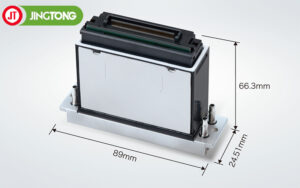
The Epson S3200-U1 has a 120.2 mm effective print width and 3,200 total nozzles, with 2,840 listed as the net nozzle count. Its design supports multi-head configurations for industrial printing systems.
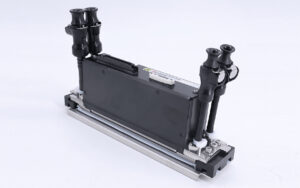
The Kyocera KJ4B-QA uses 2,656 nozzles, of which 2,558 are effective, across a 108.25 mm print width. These differences affect head spacing, overlap planning, and the number of heads required to cover a particular machine width.
A wider print swath does not automatically mean a faster finished printer. Actual throughput also depends on the number of heads, carriage or web speed, pass count, resolution, and image coverage.
Droplet Control and Printing Quality
The S3200 supports multiple droplet sizes through grayscale operation. This can help balance fine detail and tonal smoothness in applications where the selected ink and operating mode are compatible.
The KJ4B-QA supports specified drop volumes of 5, 7, and 12 pL, with 18 pL available under limited operating conditions for applicable configurations. Larger droplets can be useful when greater ink deposition is needed, while smaller droplets can support fine detail.
Neither approach is universally better. The result depends on the substrate, ink formulation, print distance, waveform, and desired coverage.
Ink Supply and System Requirements
The S3200-U1 uses common-channel ink circulation, which can help manage ink movement within the printhead. It also has specific requirements for ink viscosity and system pressure.
The standard KJ4B-QA is designed for aqueous ink and does not offer nozzle recirculation. Its ink delivery system must still maintain suitable pressure, filtration, temperature, and ink quality.
Do not apply the same ink or supply-system settings to both printheads without confirming compatibility. Their ink chemistries and operating requirements differ.
Which Printhead Fits Your Application?
The Epson S3200-U1 may be suitable for compatible UV or eco-solvent industrial systems that benefit from a wider print swath and grayscale droplet control. The KJ4B-QA is a candidate for aqueous printing systems, including suitable textile and industrial applications.
Before selecting either head, verify the exact part number, ink type, electronics, mounting arrangement, waveform, and required production conditions. Compare sample output and throughput using equivalent settings rather than relying on isolated frequency figures.
Conclusion
Epson S3200 and Kyocera KJ4B-QA are designed for different system requirements. The S3200-U1 offers a wider effective print width and supports UV or eco-solvent ink, while the KJ4B-QA targets aqueous ink applications. Correct model selection and ink-system compatibility are essential for reliable industrial printing.