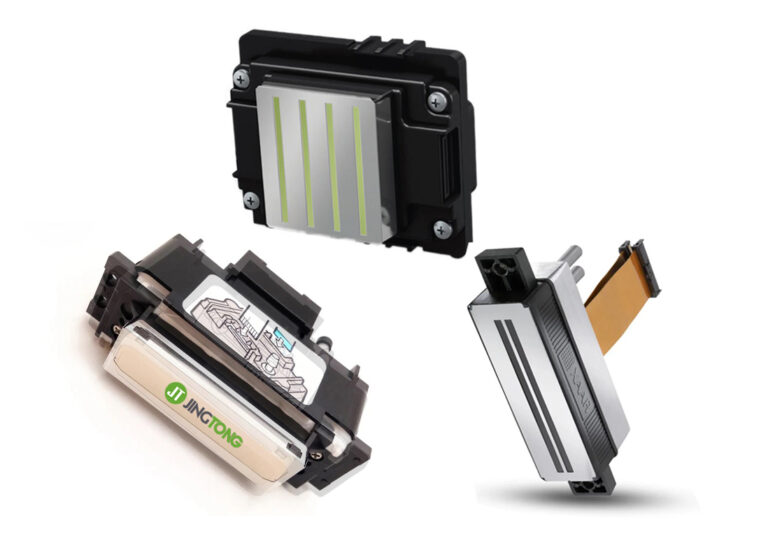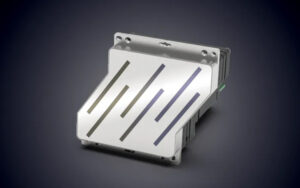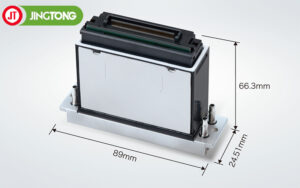
The Epson T3200 vs Ricoh Gen6 comparison is relevant to manufacturers and buyers evaluating printheads for industrial UV printing. Both product families support production-oriented printing, but they use different nozzle configurations and offer different ink compatibility options.
The Epson T3200-U3-2 is designed for UV ink, while Ricoh Gen6 models MH5320 and MH5340 support UV, solvent, and aqueous-based inks according to Ricoh’s specifications. The best choice depends on the printer design, required ink system, production target, and output quality.
Key Specifications Compared
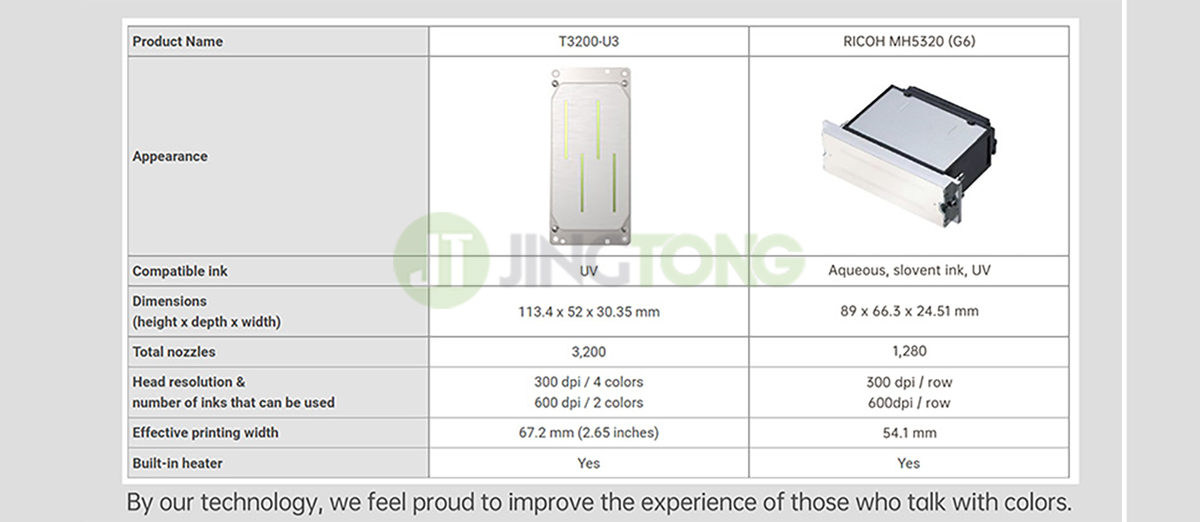
| Specification | Epson T3200-U3-2 | Ricoh MH5320 | Ricoh MH5340 |
|---|---|---|---|
| Ink compatibility | UV | UV, solvent, aqueous | UV, solvent, aqueous |
| Total nozzles | 3,200 | 1,280 | 1,280 |
| Effective print width | 67.2 mm | 54.1 mm | 54.1 mm |
| Maximum colors per head | 4 | 2 | 4 |
| Integrated heater | Yes | Yes | Yes |
| Grayscale printing | Yes | Yes | Yes |
Confirm the exact printhead generation and model before purchasing.
Nozzle Configuration and Print Width
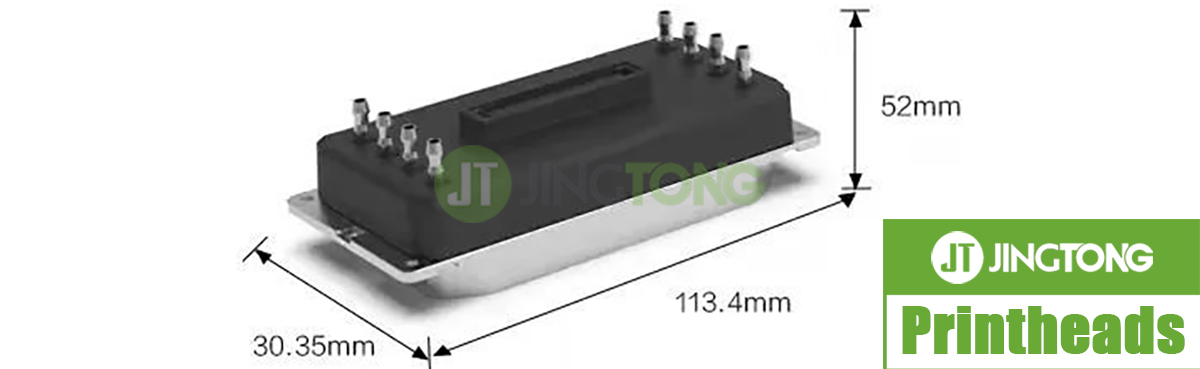
The T3200-U3-2 has 3,200 nozzles and a 67.2 mm effective print width. Its wide print area and multi-color design can help simplify printhead arrangement in compatible UV printing systems.
Ricoh MH5320 and MH5340 have 1,280 nozzles and a 54.1 mm print width. Ricoh uses four staggered nozzle rows, with the available color configuration affecting how those rows are allocated.
A higher nozzle count does not automatically mean higher finished-print quality or faster output. Print resolution, number of installed heads, pass count, waveform, machine movement, and ink curing all influence actual performance.
Ink Compatibility and Temperature Control
The T3200-U3-2 is specified for UV ink and includes a built-in heater. The newer design supports ink heating up to 50°C, helping accommodate a wider range of compatible UV inks.
Ricoh MH5320/MH5340 supports UV, solvent, and aqueous-based inks, offering greater flexibility across different printing applications. These heads also include integrated heating and temperature monitoring.
Ink compatibility should be checked against the exact printhead model and ink formulation. A broader stated compatibility range does not mean every ink can be used without system adjustments.
Grayscale and Production Performance
Both product families support grayscale printing, which can help produce smooth gradients and detailed images. Ricoh specifies a maximum grayscale frequency of 50 kHz for MH5320/MH5340 under its stated test conditions. Epson lists its own droplet-ejection specifications for the T3200 series.
These figures should not be compared as direct machine-speed measurements. Real production output depends on the selected grayscale mode, print resolution, ink characteristics, head arrangement, and operating conditions.
Which Printhead Is Better for UV Printing?
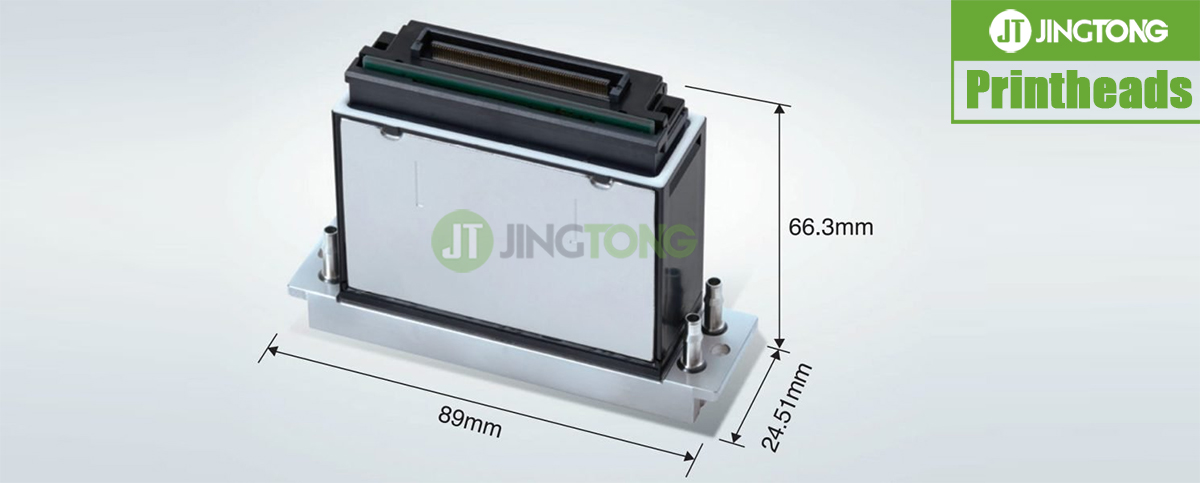
The Epson T3200-U3-2 may suit UV printer designs that benefit from a wider effective print width and a four-color head configuration. Ricoh Gen6 may be preferable when the application requires its supported ink options or a particular two-color or four-color configuration.
Before making a decision, compare actual print samples, production rates under equivalent settings, ink costs, maintenance requirements, and the availability of compatible electronics and replacement parts.
Conclusion
Epson T3200 and Ricoh Gen6 offer different strengths rather than one universally superior solution. The T3200-U3-2 provides a wider effective print width and a higher nozzle count, while Ricoh MH5320/MH5340 supports a wider range of ink types. Matching the printhead to the complete printer system is the key to reliable performance.