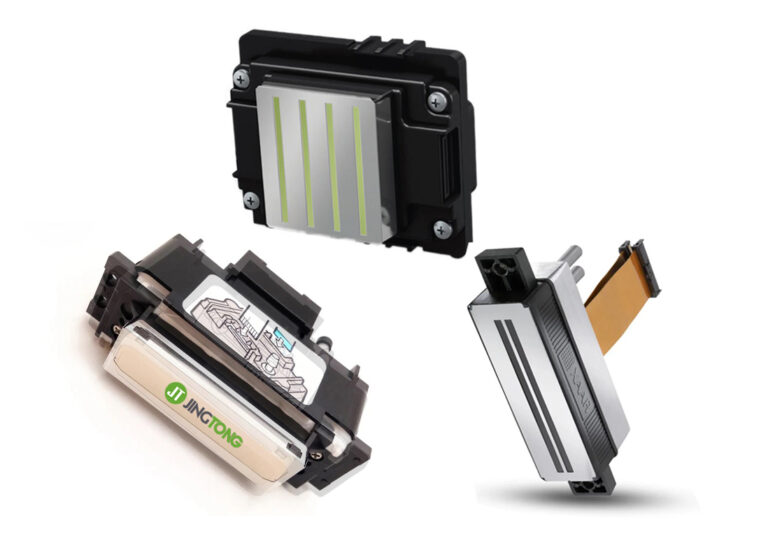
An industrial printhead comparison helps printer manufacturers and print service providers select a suitable printing platform for their production needs. The XP600, Epson i3200, KM1024i and KM512i differ in nozzle configuration, ink compatibility, integration requirements and typical applications. The best choice depends on the complete printing system rather than one specification alone.
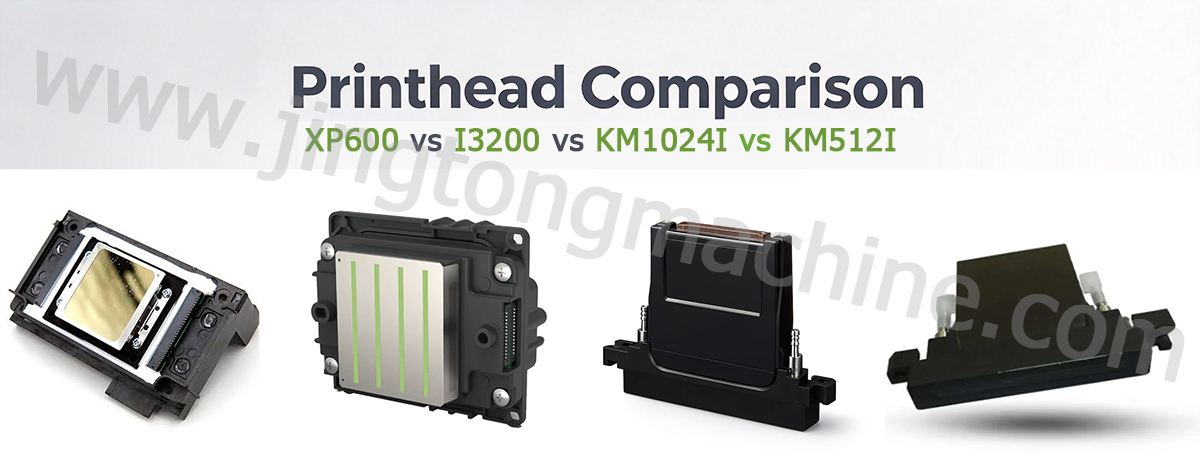
1. Overview of the Four Printhead Platforms
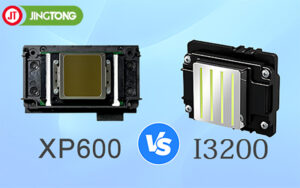
● XP600: Commonly used in entry-level and cost-conscious printing systems, including compatible DTF and other configurations.
● Epson i3200: A 3,200-nozzle series available in different variants for specific ink systems.
● Konica Minolta KM512i: A 512-nozzle industrial platform used in selected wide-format and solvent printing systems.
● Konica Minolta KM1024i: A 1,024-nozzle industrial platform used in compatible high-throughput and single-pass systems.
These platforms target different requirements. Their suitability depends on ink chemistry, printer design and intended workload.
2. Key Specification Comparison
The following figures are drawn from the reference guide and are intended for initial comparison. Confirm the exact model and manufacturer datasheet before using specifications for purchasing or engineering decisions.
| Parameter | XP600 | Epson i3200-A1 | KM512i LNB | KM1024i MHE |
|---|---|---|---|---|
| Nozzle count | 1,080 | 3,200 | 512 | 1,024 |
| Listed droplet size | 4.5–40 pL | 6 pL, binary mode | 30 pL | 13 pL |
| Listed maximum frequency | Approx. 46 kHz | 43.2 kHz | 30.4 kHz | Up to 45 kHz |
| Listed resolution | Up to 1,440 dpi | Up to 1,200 dpi | 360 dpi | 360 npi |
| Typical application | Compatible DTF and hybrid systems | Compatible aqueous printing | Selected solvent systems | Compatible industrial and packaging systems |
Values may be measured under different operating conditions, so they should not be used as a direct ranking of print quality or production speed.
3. XP600: Entry-Level Printing Systems
The XP600 is widely used in compact and cost-sensitive printing equipment. It can be suitable for businesses starting with smaller production volumes, provided the selected printer and ink system are compatible.
When considering the XP600 for regular production, evaluate actual print quality, maintenance needs, expected workload and replacement costs. It should not automatically be treated as equivalent to a printhead platform designed for demanding continuous industrial operation.
4. Epson i3200: Multiple Ink-Specific Variants
The i3200 series offers a higher nozzle count and different variants for specific ink chemistries:
● I3200-A1: Compatible aqueous ink systems.
● I3200-E1: Compatible eco-solvent ink systems.
● I3200-U1: Compatible UV-curable ink systems.
These versions are not interchangeable simply because they belong to the same family. Drive electronics, waveform settings and ink delivery must match the exact model.
5. KM512i and KM1024i: Industrial Production
The KM512i and KM1024i are used in industrial systems that require specific ink delivery and control architectures. The KM512i LNB configuration in the reference guide uses a larger nominal droplet, while the KM1024i MHE configuration is listed with a smaller nominal droplet and a higher firing frequency.
Actual output depends on the complete printer design, including printhead arrangement, media movement, ink supply and controller capability. The KM1024i may be suitable for compatible single-pass applications, but not every variant supports every industrial ink type.
6. Ink Compatibility and Integration
Before selecting any printhead, verify the ink formulation, viscosity, temperature requirements and filtration specifications. Also confirm electrical interfaces, drive waveforms, mounting dimensions and maintenance procedures.
Incorrect ink or incompatible electronics may lead to unstable jetting, nozzle problems or printhead damage. Always confirm the exact model and its approved operating conditions.
Conclusion
The XP600, Epson i3200, KM512i and KM1024i each serve different printing needs. Comparing their specifications is a useful starting point, but the final choice should reflect ink compatibility, production requirements, integration complexity and total operating cost.